


You've noticed it. You sit down at home, to-do list ready, full intentions. Three hours later you've reorganised a drawer, scrolled through something depressing, and eaten a suspicious amount of cheese.
Then you take your laptop to a café. A library. A hotel lobby full of strangers tapping away at their own keyboards. Something shifts. You focus.
This isn't a fluke, and it isn't just about the ambient noise. There's a growing body of research, particularly in the ADHD community, that explains exactly why the mere presence of other people working can unlock productivity you didn't know you had. It's called body doubling, and it might be one of the most underrated tools for getting things done.
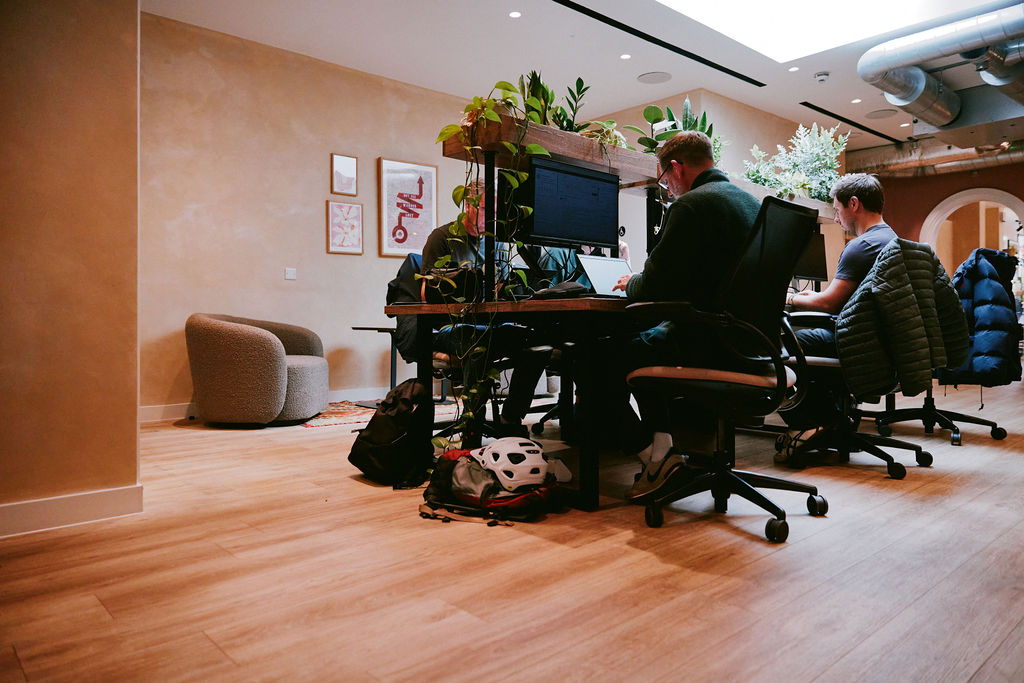
.jpg)
Body doubling is exactly what it sounds like: having another person physically present while you work. Not helping. Not supervising. Not even talking to you. Just being there.
The concept emerged from the ADHD therapy world, where clinicians noticed that many of their patients could tackle tasks they'd been avoiding for weeks—folding laundry, filing taxes, writing reports—simply by having someone else in the room doing their own thing.
Dr. Russell Barkley, one of the leading researchers in ADHD, has long noted that people with ADHD are highly sensitive to their environment. External cues—visual, social, auditory—often serve as the "scaffold" that the ADHD brain struggles to build internally. A body double becomes a living, breathing anchor to the present moment.

ADHD is fundamentally a disorder of executive function, the brain's project manager. Planning, prioritising, initiating tasks, and sustaining attention all fall under this umbrella. And the prefrontal cortex, which governs these skills, is chronically under-stimulated in ADHD brains.
This is where body doubling does something remarkable. The presence of another person provides just enough environmental stimulation to nudge the prefrontal cortex into action without overwhelming it. It's the Goldilocks zone of social pressure—not the stress of a supervisor watching over your shoulder, but the gentle, ambient awareness that someone else is being productive right now.
A 2020 study published in the Journal of Attention Disorders found that environmental modifications—including social accountability structures—significantly improved task completion rates in adults with ADHD. While body doubling wasn't isolated as a variable, the principle aligns perfectly: changing the context changes the behaviour.
🛍 No social obligation. Friends invite conversation. Strangers let you disappear into your work.
📍 Implicit social norms. In a café, the unspoken rule is: we're all here to do our thing. That norm is contagious.
🪑 Mild positive pressure. You're less likely to open Instagram when the person next to you is deep in a spreadsheet.
📍 Novelty factor. A changing environment keeps the brain engaged—critical for ADHD, helpful for everyone.
Here's where it gets interesting for all of us. You don't need an ADHD diagnosis to benefit from body doubling. The psychological mechanisms at play—social facilitation, environmental cueing, and accountability—are universal.
Social facilitation theory, first described by psychologist Norman Triplett in 1898, demonstrated that people perform simple or well-practised tasks faster in the presence of others. Over a century of research has refined this: the presence of others increases physiological arousal, which enhances performance on tasks we're comfortable with.
Then there's the concept of "task contagion." Behavioural research shows that seeing others engaged in focused work activates mirror neuron pathways. Productivity, it turns out, is socially infectious. When you sit in a room of people working, your brain receives constant micro-signals: this is what we do here. We focus.
And let's not forget commitment devices. Behavioural economists talk about these all the time—structures that make it harder to deviate from your intentions. Going to a café to work is a commitment device. You've left the house, spent money on coffee, and set up your laptop. Walking away from that feels like more of a loss than closing a laptop lid at home.
(1) Relocate Strategically
When you're stuck, move to a space where other people are working. Cafés, libraries, co-working spaces, even a busy park bench.
(2) Try virtual body doubling
Platforms like Focusmate pair you with a stranger on video for a 50-minute work session. No talking—just mutual presence. It's surprisingly powerful.
(3) Use it for your hardest tasks
Save body doubling for the tasks you keep avoiding. The brain gets more from this effect when motivation is lowest.
(4) Don't overthink it
You don't need a structured system. Sometimes just asking a flatmate to sit in the same room while you work is enough.

